

Let me tell you something I hear almost every week in my clinic.
A patient sits across from me — clearly in pain, clearly struggling with daily life and the moment I mention knee replacement, they pull back. “Doctor, I’ll manage. I’m not ready for surgery.”
I ask them: how long have you been managing?
Almost always, the answer is years. Years of painkillers that work less and less. Years of declining stairs, avoiding walks, missing family functions. Mornings that begin with the question — “how bad is the knee going to be today?”
And when I explain what modern knee replacement in Indore actually looks like — the smaller incisions, the faster recovery, the pain management that’s genuinely better than people expect something shifts. They realise they’ve been afraid of a surgery that no longer exists the way they imagined it.
That’s exactly why I’m writing this blog. Because fear built on outdated information is keeping people in pain they don’t have to live with.
First — Let’s Understand the Difference Between Arthroscopy and Knee Replacement
These two terms are often used together and frequently confused. Let me clarify them simply.
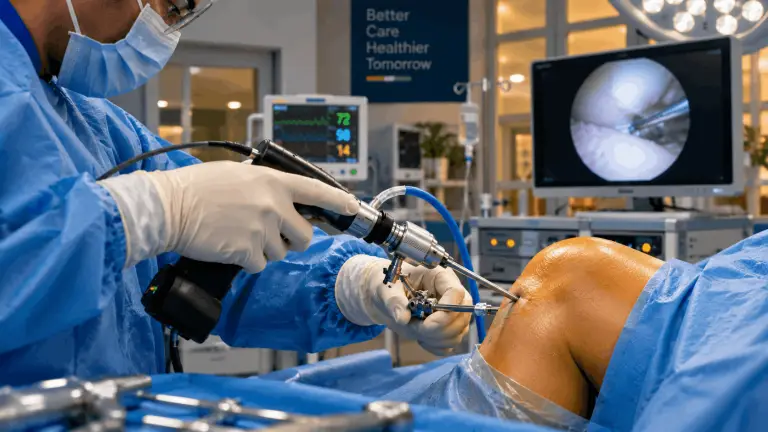
Knee arthroscopy is a minimally invasive procedure where a small camera the arthroscope is inserted into the knee through tiny incisions. It allows the surgeon to directly visualise the inside of the knee joint and treat specific problems like meniscal tears, ligament injuries, cartilage damage, and loose bodies — all without a large incision. Recovery is measured in weeks, not months, and most patients go home the same day or the next morning.
Knee replacement — or knee arthroplasty — is a different procedure entirely. It involves removing the damaged joint surfaces and replacing them with precisely engineered prosthetic components. It’s recommended when the joint has deteriorated to the point where arthroscopy and conservative treatments can no longer provide adequate pain relief and function.
When I talk about arthroscopy knee replacement in Indore in this blog, I’m referring to modern knee replacement surgery that incorporates minimally invasive surgical principles — smaller incisions, muscle-sparing techniques, and precision alignment tools that have transformed the procedure from what it used to be into something significantly less daunting and significantly more effective.
How Modern Knee Replacement Has Changed — And Why It Matters
The knee replacement that most people are afraid of is the knee replacement of twenty years ago. Large incisions. Significant muscle damage. Extended hospital stays. Months of painful, slow rehabilitation.
That surgery still lives in people’s memories — in stories from parents and grandparents, in outdated information passed between friends. But it doesn’t reflect what knee replacement surgery in Indore looks like in 2026.
Smaller Incisions, Less Tissue Trauma
Modern minimally invasive knee replacement uses significantly smaller incisions than traditional surgery — and smaller incisions have direct, measurable clinical benefits. Less disruption to the surrounding muscles and soft tissue means less post-operative pain, faster healing, lower infection risk, and a recovery that progresses faster from the very beginning.
Muscle-Sparing Surgical Approaches
Traditional knee replacement required cutting through the quadriceps tendon and muscle to access the joint. Modern approaches are designed specifically to spare or minimise disruption to the quadriceps — the primary muscle responsible for straightening the knee.
This matters enormously for recovery. Patients whose quadriceps is minimally disturbed during surgery can begin activating and strengthening that muscle much sooner after the procedure — which is one of the primary reasons modern knee replacement patients are standing within 24 hours and walking within days rather than weeks.
Precision Alignment and Surgical Accuracy
Component alignment in knee replacement directly determines how well the knee functions, how naturally it moves, and how long the prosthetic implant lasts. Poor alignment causes accelerated wear, instability, and premature implant failure.
Modern knee replacement in Indore uses precision instrumentation — including patient-specific instruments and computer-assisted alignment techniques — that achieves component positioning accuracy well beyond what traditional mechanical guides alone could provide. Better accuracy at surgery means better function and longer implant life for the patient.
Advanced Pain Management
Post-operative pain management in modern knee replacement is genuinely different from what it was. Regional nerve block anaesthesia — particularly the adductor canal block combined with periarticular infiltration analgesia — is used alongside the procedure to provide sustained, targeted pain relief that significantly reduces the amount of oral or injectable opioid medication required after surgery.
Most of my patients in Indore describe their post-operative pain as meaningfully less than they expected — particularly in the first 48 hours when the nerve block is providing effective analgesia. This changes the early recovery experience profoundly.
Who Actually Needs Knee Replacement?
Knee replacement is never the first recommendation. It becomes the right recommendation when specific clinical thresholds have been reached when conservative management has been genuinely tried and found inadequate, and when the structural damage to the joint is advanced enough that non-surgical options can no longer meaningfully help.
In practical terms, knee replacement in Indore is appropriate when:
Pain significantly limits daily activities. Walking distances you could previously manage comfortably have reduced. Climbing stairs is painful and increasingly avoided. Activities you previously enjoyed walks, travel, playing with grandchildren, attending religious functions are limited by knee pain.
Night pain is present regularly. When knee pain is waking you from sleep or preventing comfortable sleep — the joint is telling you something that deserves serious clinical attention.
Conservative treatment has been genuinely exhausted. Physiotherapy, anti-inflammatory medication, weight management, activity modification, and intra-articular injections (steroid or hyaluronic acid) should all be appropriately tried before knee replacement is considered. But when these have been optimised and found inadequate — continuing them indefinitely is not a solution. It is a delay.
Imaging confirms severe joint damage. Weight-bearing X-rays showing significant joint space narrowing, bone-on-bone contact, or bony deformity confirm the structural basis for the pain. Surgery addresses a structural problem and structural problems visible on imaging, causing significant symptoms, are the appropriate indication for surgical management.
Quality of life is genuinely compromised. This is ultimately the most human consideration and the one that matters most. When knee pain has taken away things that make life meaningful and enjoyable, that loss has clinical weight. You don’t have to wait until you can barely walk before surgery becomes appropriate.
When Arthroscopy Is the Right Choice Instead of Replacement
For patients who are younger, whose arthritis is less advanced, or who have specific mechanical problems inside the knee arthroscopy may be the right surgical intervention rather than replacement.
Knee arthroscopy in Indore is used to treat:
Meniscal tears — the meniscus is the cartilage cushion between the femur and tibia. Tears cause pain, swelling, locking, and catching sensations. In younger patients with appropriate tear patterns, meniscal repair (stitching the tear) is strongly preferred over partial removal preserving the meniscus protects the joint long-term.
ACL injuries — the anterior cruciate ligament stabilises the knee against rotational forces. ACL reconstruction using the patient’s own tendon tissue as a graft restores stability and allows return to sport and physical activity in most patients.
Cartilage damage — certain patterns of cartilage damage can be addressed arthroscopically, buying time before replacement is needed and sometimes avoiding it altogether in appropriately selected patients.
Loose bodies — fragments of cartilage or bone that have detached within the joint cause catching, locking, and pain. Arthroscopic removal resolves these symptoms rapidly.
Diagnostic arthroscopy — when clinical assessment and imaging haven’t provided a definitive explanation for knee symptoms, direct visualisation through arthroscopy provides answers that guide further management.
The decision between arthroscopy and replacement is always made through thorough clinical assessment your age, your imaging findings, your activity level, and the specific nature of your knee pathology all contribute to determining the right approach for you.

What Recovery From Knee Replacement Actually Looks Like — Week by Week
Recovery is the dimension patients want most clarity on and the area where expectations most frequently diverge from modern reality. Here’s an honest, realistic picture.
Day 1–2: Earlier Than You Expect
This surprises almost every patient. Within 24 hours of knee replacement surgery, physiotherapy begins. You stand, take supported steps with a walker, and begin gentle exercises ankle pumps, quadriceps activation, straight-leg raises.
This isn’t aggressive or risky. Early mobilisation is essential, it prevents blood clots, reduces swelling, maintains joint mobility, and sets the trajectory for the entire recovery. Patients who move early consistently recover better than those who rest longer.
Pain is managed through the multimodal protocol — nerve block, anti-inflammatories, and oral analgesics. Most patients are genuinely comfortable during this phase.
Week 1–2: Going Home and Building Confidence
Most knee replacement patients in Indore are discharged within 3–5 days. Discharge happens when you can walk safely with a walker, manage stairs with support, and demonstrate adequate pain control on oral medication.
Home physiotherapy continues daily. Goals during this phase: reduce swelling, increase walking duration progressively, achieve 90 degrees of knee flexion (the benchmark for most daily activities), and build confidence with the new knee.
By the end of week two, basic daily activities moving around the house, using the bathroom independently, sitting and rising from chairs are being managed with increasing ease.
Week 3–6: The Progress Becomes Visible
Recovery accelerates noticeably during this phase and patients feel it. Walking distance increases meaningfully week to week. Stairs become progressively more manageable. Many patients discontinue the walker during this period, transitioning to a stick for outdoor confidence or dispensing with walking aids entirely.
Outpatient physiotherapy during this phase focuses on strength building and gait normalisation returning to a walking pattern that is natural rather than compensatory. Driving typically becomes possible around six weeks after surgery, assessed individually based on which knee was replaced and the patient’s specific recovery progress.
Month 2–3: Back to Normal Life
This is when the transformation becomes genuinely apparent both to patients and to the people around them. Pain continues reducing. Strength builds steadily. Daily activities feel normal rather than effortful.
Most patients return to desk work during this phase. Social activities, family functions, shopping, visiting these resume, and the comparison between current life and the months before surgery becomes stark and positive.
Month 3–6: Full Recovery
By three months, the vast majority of my knee replacement patients in Indore are walking freely, managing stairs comfortably, sleeping without knee pain, and engaging with daily life in ways they hadn’t been able to for years.
Full resolution of residual swelling and achievement of maximum range of motion continues through the first six months to one year but the functional milestones that matter most to patients’ daily lives are largely in place by the three-month mark.
The most consistent feedback I receive at follow-up is some version of: “I wish I had done this sooner.”
Total vs. Partial Knee Replacement — Understanding Your Options
Total knee replacement replaces all three compartments of the knee the inner compartment, the outer compartment, and the kneecap joint. It’s indicated when arthritis or damage is widespread across the knee, which is the case for the majority of patients presenting for replacement.
Partial (unicompartmental) knee replacement replaces only the damaged compartment most commonly the inner (medial) side preserving the healthy cartilage and bone in the remaining compartments. For carefully selected patients, it offers a smaller incision, faster recovery, less blood loss, and a knee that feels more natural after surgery.
Partial replacement requires specific patient selection criteria the uninvolved compartments must be relatively healthy, ligament stability must be maintained, and the patient’s functional demands must be appropriate for the prosthetic design. Not every patient with single-compartment disease is an ideal candidate but for those who are, it is a genuinely excellent option.
The decision between total and partial replacement is made through thorough clinical assessment and imaging review individualised to the patient, not driven by protocol.
Common Myths About Knee Replacement — Addressed Honestly
“The recovery takes months and I’ll be bedridden.”
No. Most patients are walking within 24 hours and discharged within 5 days. The recovery requires effort and physiotherapy — but bedridden is not the modern experience.
“The implant won’t last and I’ll need it done again soon.”
Modern knee implants have a 90–95% probability of lasting 15–20 years in appropriately selected and managed patients. Many last significantly longer.
“I’m too old for surgery.”
Age alone is not a contraindication. Medical fitness matters more than age. Many patients in their seventies and eighties have excellent outcomes from knee replacement when their overall health is appropriately assessed and managed.
“I should wait as long as possible.”
Waiting unnecessarily once surgery is genuinely indicated allows further muscle weakness, further joint damage, and further impact on quality of life. Longer waiting does not make surgery safer or recovery easier. In many respects, it does the opposite.
“Physiotherapy can fix what surgery is needed for.”
For mild to moderate arthritis, physiotherapy is genuinely valuable and should always be tried. But for advanced joint damage with bone-on-bone arthritis, physiotherapy manages symptoms, it cannot repair structural damage. When the joint is gone, it needs replacing.
What Knee Replacement Can and Cannot Do Honest Expectations
Being realistic about outcomes is something I consider as important as the surgery itself. Patients with realistic expectations report higher satisfaction even when the surgical outcome is identical.
What knee replacement reliably delivers:
- Dramatic pain relief — the most consistent and most immediate benefit
- Restored functional capacity — walking, stairs, daily activities without pain dominating
- Significantly improved quality of life across physical, social, and emotional dimensions
- Return to low-impact physical activity — walking, swimming, cycling, light exercise
What knee replacement doesn’t always achieve:
- The exact feel of a natural knee — a replaced knee functions very well but is different from a biological joint
- Return to high-impact sports — running, jumping, contact sports accelerate implant wear and are generally not recommended
- Complete elimination of every sensation — some patients have mild residual awareness with demanding activities
The goal of knee replacement is not a perfect knee. It is a significantly better knee — one that lets you live fully and actively, without the limitation and pain of severe arthritis defining your daily experience.
Why Patients Across Indore Choose Dr. Susheel Soni for Knee Surgery
Surgical outcomes in knee replacement depend significantly on the expertise, judgment, and commitment of the treating surgeon. What my patients in Indore consistently experience:
Honest clinical assessment. If your knee can be genuinely managed with less invasive treatment, I will tell you. I don’t recommend surgery when it isn’t the right next step and I don’t delay recommending it when it clearly is.
Complete pre-operative education. Every patient deserves to understand exactly what their procedure involves, what recovery realistically requires, and what outcomes they can genuinely expect. Informed patients make better decisions and recover better both are true.
Technical precision in surgery. The accuracy of component alignment determines how the knee functions and how long it lasts. This is where surgical skill and experience matter most and where I apply the most demanding attention to detail.
Genuine post-operative commitment. My responsibility to patients doesn’t end when surgery is complete. I follow knee replacement patients closely through recovery monitoring progress, adjusting rehabilitation guidance, and remaining available for concerns between scheduled appointments.
Your Next Step — A Consultation, Not a Commitment
If knee pain has been limiting your life and you’ve been telling yourself you’ll manage a little longer I want to offer you a different perspective.
A consultation is not a commitment to surgery. It is simply a conversation one where you get an accurate diagnosis, honest information about your options, and clear guidance about what is and isn’t indicated for your specific situation.
You might leave that consultation with a physiotherapy plan. You might leave with an arthroscopy recommendation. You might leave understanding that knee replacement is the right next step earlier than you assumed. Whatever the outcome you’ll leave with more clarity than you currently have.
Knee pain doesn’t have to be your normal. For most people living with it, genuinely, it doesn’t.
Come in. Let’s have that conversation.
Follow Dr. Susheel Soni — Orthopedic Education, Honestly Shared
📸 Follow for orthopedic education: https://www.instagram.com/drsusheelsoni0/
▶️ Watch detailed videos: https://www.youtube.com/@drsusheelsoni
Because the best surgical outcomes start with the best-informed patients.
Considering knee arthroscopy or knee replacement in Indore? Book a consultation with Dr. Susheel Soni experienced orthopedic surgeon, minimally invasive techniques, and honest patient-centered care that actually gets you moving freely again.