

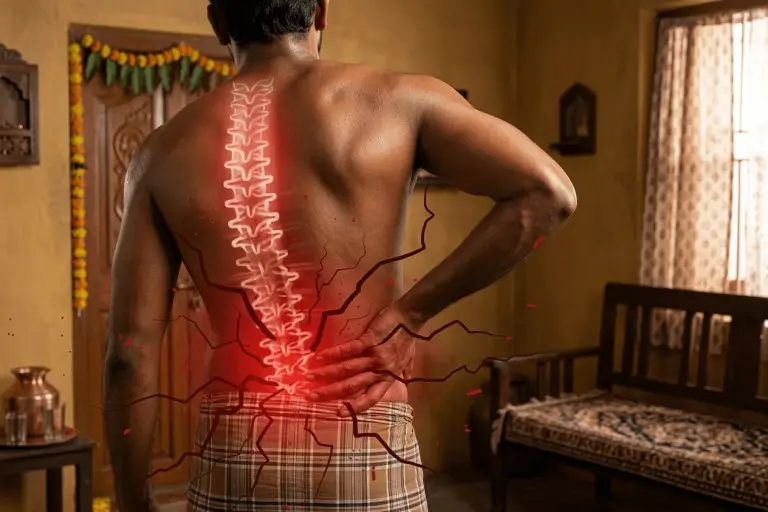
Back pain is back pain until it isn’t.
That’s the thing most people don’t realize. Not all back pain is the same, it doesn’t all come from the same place, and it definitely doesn’t all need the same treatment. Two people can walk into my clinic with what feels like identical back pain and one has a simple muscle strain that will heal in a week, while the other has a slipped disc that needs careful, structured treatment.
The problem is, both conditions can feel remarkably similar in the beginning. And treating a slipped disc like a muscle strain or vice versa can either delay recovery significantly or make things considerably worse.
As an orthopedic surgeon in Indore, this is one of the most common diagnostic conversations I have with patients. So let me break it down clearly, simply, and in a way that actually helps you understand what might be happening in your back and what to do about it.
First, Let’s Understand What Each Condition Actually Is
Before comparing them, it helps to understand what’s actually happening inside your body with each condition.
Muscle Strain occurs when the muscles or ligaments supporting your spine are overstretched or torn. This happens from sudden movements, lifting something heavy incorrectly, an awkward twist, or simply overusing your back muscles during physical activity. The muscle tissue itself is injured and like any muscle injury in your body, it hurts, it swells, and it needs time to heal.
Slip Disc medically called a herniated or prolapsed disc is a different problem entirely. Between each vertebra in your spine sits a disc: a soft, cushioning structure with a tough outer shell and a gel-like centre. When that outer shell weakens or tears, the inner gel pushes outward pressing on surrounding nerves. It’s this nerve compression that creates the distinctive symptoms that separate a slipped disc from a muscle strain.
Same area of the body. Very different underlying problem. Very different treatment approach.
How the Pain Feels The First Clue
One of the most telling differences between these two conditions is the nature and location of the pain itself.
Muscle Strain Pain:
- Usually felt as a dull, aching, or throbbing pain localized to the back
- Stays in the back it doesn’t travel elsewhere
- Tends to feel worse with movement and better with rest
- Typically improves noticeably within a few days to a week
- Often accompanied by muscle tightness or spasms in the affected area
- You can usually identify a clear trigger “I moved the wrong way,” “I lifted something heavy,” “I played cricket after months”
Slip Disc Pain:
- Often starts in the back but frequently travels down into the buttocks, legs, and sometimes all the way to the feet
- This radiating, shooting pain is called sciatica and it’s one of the hallmark signs of disc involvement
- Can cause a burning, sharp, or electric-shock-like sensation rather than a simple ache
- May worsen significantly when sitting, coughing, sneezing, or straining
- Often more intense and persistent than muscle strain pain
- Doesn’t always have an obvious single trigger sometimes it develops gradually
If your back pain travels down your leg that is a significant clue that disc involvement is likely. Muscle strains do not cause leg pain.
Symptoms That Point Clearly to a Slipped Disc
While muscle strain and slip disc can share some early symptoms, certain signs point almost exclusively toward a herniated disc and should not be ignored or dismissed as “just a back strain.”
Watch for these slip disc symptoms:
Radiating leg pain (Sciatica): A shooting pain that travels from your lower back through your buttock and down one or both legs. Some patients describe it as an electric shock running down the leg. Others feel a burning or tingling sensation. This is nerve pain and it’s the most telling sign of disc involvement.
Numbness or tingling: Feeling of pins and needles, or patches of numbness in your thighs, calves, feet, or toes. This happens because the herniated disc is pressing on a nerve that supplies sensation to those areas.
Muscle weakness: Weakness in one leg difficulty standing on tiptoe, lifting the foot properly, or climbing stairs. When a disc compresses a nerve severely enough, it can affect the strength signals traveling through that nerve to your muscles.
Pain that worsens with sitting: Many slip disc patients find that sitting particularly for long periods dramatically worsens their pain. This is because sitting increases the pressure on spinal discs significantly.
Pain that improves with walking: Interestingly, many patients with herniated discs find that gentle walking is more comfortable than sitting still. This is the opposite of what most people expect and is a useful clinical observation.
Symptoms that affect bladder or bowel function: This is rare but critically important. If a slipped disc causes any difficulty with bladder or bowel control this is a medical emergency called Cauda Equina Syndrome and requires immediate hospital attention without delay.
Symptoms That Point More Toward Muscle Strain
While muscle strain is simpler in nature, it’s not always less painful in fact, acute muscle strains can be intensely painful, sometimes more immediately painful than a disc issue.
Signs that suggest muscle strain:
- Clear trigger event a specific moment you felt something “go” in your back
- Pain is localized entirely to the back no leg symptoms whatsoever
- Significant muscle tightness, spasms, or tenderness to touch over the muscle
- Movement in certain directions is painful but other movements feel okay
- Significant improvement within 3–5 days with rest, gentle movement, and basic medication
- Pain that responds well to heat application or a gentle massage
- No neurological symptoms no numbness, no tingling, no weakness in the legs
The key characteristic of muscle strain is that it improves relatively quickly with basic care. If your “muscle strain” isn’t getting better within 1–2 weeks it’s time to reconsider whether it’s actually a muscle strain at all.
How Are They Diagnosed?
This is where professional evaluation becomes essential because symptoms alone don’t always tell the complete story, and treating the wrong condition can genuinely delay your recovery.
Clinical examination is always the starting point. A trained orthopedic surgeon will assess your pain pattern, test your reflexes, evaluate muscle strength, perform specific diagnostic maneuvers to identify nerve involvement, and ask detailed questions about your symptoms and their progression.
For muscle strain: In most straightforward cases, a clinical examination is sufficient to diagnose and begin treatment. Basic X-rays may be done to rule out any bony issues.
For suspected slip disc: An MRI scan is the gold standard investigation. It provides a detailed picture of the discs, the nerves, and the surrounding structures showing exactly which disc is involved, how severely it has herniated, and which nerve is being affected. This information directly guides the treatment plan.
This is why I always tell patients don’t self-diagnose back pain based on what you read online. The examination and the right investigation make all the difference.
Treatment Where the Two Conditions Diverge Significantly
Treating Muscle Strain:
Most muscle strains respond very well to a structured conservative approach:
- Relative rest — avoiding the activity that caused the strain while maintaining gentle movement
- Ice and heat — ice in the first 24–48 hours to reduce inflammation, heat after that to relax muscle spasms
- Anti-inflammatory medication — to manage pain and reduce swelling
- Physiotherapy — targeted exercises to restore strength and flexibility, and to prevent recurrence
- Postural correction — identifying and addressing the habits that led to the strain
Most muscle strains resolve completely within 2–6 weeks with proper care. The goal of treatment is not just recovery but understanding and correcting what caused the strain in the first place.
Treating Slip Disc:
Slipped disc treatment is more nuanced and depends significantly on the severity of the herniation and the degree of nerve involvement.
Conservative treatment is almost always the first approach and it works for the majority of patients:
- Physiotherapy: Specific exercises that decompress the affected disc, strengthen core muscles, and improve spinal stability. This is the cornerstone of slip disc recovery.
- Medication: Pain relief, anti-inflammatories, nerve pain medications, and sometimes short courses of oral steroids to reduce nerve inflammation
- Activity modification: Understanding which positions and movements aggravate symptoms and adjusting daily activities accordingly
- Posture and ergonomics: Correcting sitting posture, sleeping position, and workstation setup
Epidural steroid injections may be recommended when pain is severe and not responding adequately to oral medication and physiotherapy. These targeted injections deliver anti-inflammatory medication directly to the affected nerve providing significant relief that allows the patient to engage more effectively with physiotherapy.
Surgery is considered only when conservative treatment has been tried thoroughly and failed, when neurological symptoms are severe or worsening, or in emergency situations like Cauda Equina Syndrome. The most common surgical procedure for a herniated disc is a microdiscectomy a minimally invasive procedure with excellent outcomes in appropriately selected patients.
The important message here is that most slipped disc patients, the majority do not end up needing surgery. With the right treatment, patience, and commitment to physiotherapy, remarkable recovery is achievable.
Common Mistakes People Make With Both Conditions
Over years of practice in Indore, I’ve seen the same mistakes repeatedly and I want to help you avoid them.
Resting completely and not moving at all: For both conditions, complete bed rest is now considered counterproductive after the first day or two. Gentle, appropriate movement aids recovery far better than total immobilization. The right physiotherapist will guide you on exactly what movements help and which to avoid.
Self-medicating with painkillers indefinitely: Painkillers manage symptoms they don’t treat the underlying cause. Using them long-term without addressing the actual problem leads to dependency and delayed recovery. They should be a short-term bridge to allow you to engage with proper treatment.
Assuming it will go away on its own: Muscle strains usually do improve with time. Slipped discs sometimes do too but often need structured treatment to prevent recurrence and to protect the nerve from prolonged compression.
Delaying consultation because the pain “isn’t that bad yet”: With slip disc particularly, waiting too long especially when neurological symptoms are present can prolong nerve damage and complicate recovery. Earlier evaluation consistently leads to better outcomes.
When Should You See an Orthopedic Doctor?
For muscle strain, see a doctor if:
- Pain hasn’t improved meaningfully after 1–2 weeks of basic care
- Pain is severe enough to significantly limit daily activities
- You’ve had multiple similar episodes recurring muscle strains often signal an underlying issue worth addressing
For suspected slip disc, see a doctor if:
- You have any pain radiating into your legs
- You experience numbness, tingling, or weakness in your lower limbs
- Sitting for even short periods significantly worsens your pain
- Pain is not responding to rest and basic medication
- You notice any bladder or bowel changes seek emergency care immediately
A Word From My Experience
The patients I worry about most are not the ones who come in with severe pain. The ones I worry about are those who come in months after symptoms started having self-treated a slipped disc as a muscle strain, having allowed nerve compression to persist far longer than it needed to.
Nerves are forgiving but not indefinitely. The longer a nerve is compressed without treatment, the longer recovery takes, and in some cases, the recovery is incomplete.
Your back pain deserves a proper diagnosis not a guess, not a Google search result, and not a friend’s well-meaning advice. A proper clinical evaluation and the right investigation will tell you exactly what you’re dealing with and that knowledge changes everything about how effectively you can recover.
Because knowing what’s wrong is the first step toward making it right. 💙
Experiencing back pain or leg pain in Indore? Dr. Susheel Soni, Orthopedic Surgeon, provides expert diagnosis and personalized treatment for slip disc, muscle strain, and all spinal conditions. Book your consultation today and take the first step toward a pain-free life.